
 by Andrea Ciulu
7 MIN. READ
15.06.2026
by Andrea Ciulu
7 MIN. READ
by Andrea Ciulu
7 MIN. READ
15.06.2026
by Andrea Ciulu
7 MIN. READ

A lot of your business results happen in your customers’ mindspace. And brand architecture makes sure they follow the right routes.
Brand architecture is one of those fancy terms from the branding jargon that most down-to-earth companies will probably scoff about.
Just give me my brand and be done with it! Yes, to be honest brand architecture is not something you will be using on day one, and yet you will probably need it sooner than later.
What’s brand architecture then?
Brand architecture maps the relative positioning between the brand or sub-brands that live inside your company and the subsequent rules of interaction between them.
This can sound super-complicated, especially if you are just starting out. In that case, it’s easy to equate your brand and your business. They are actually the same things.
But with time, your business will probably differentiate. You might want to explore new markets, or add new product lines, or you might even acquire and incorporate other businesses into your own.
In that case, the original brand will soon feel like too tight a dress for everything your business has become, like a restaurant having too many things on its menu.
This has mostly to do with your customers’ perception.
A monolithic brand can make it hard to understand how your offer is articulated. If your company starts by producing videogame consoles and then it starts producing vacuum cleaners, having just one name could easily be a problem.
Why? It all boils down to how branding works. When building a brand, we mostly strive for memorability and brand associations (eg. what values, functional benefits and other characteristics you associate with the brand).
When dealing with a brand architecture, the two might be in conflict: using the main brand again and again will surely improve memorability, but it will mess up brand associations big time, especially if your service or product lines differ by a great extent.
This is why brand architecture is an art of nuances, balancing between the two objectives. This has led to many “models”, but truth is the right model is always custom and we increasingly see companies adopting hybrid brand architectures.
The gradient of brand architecture: from monolithic to plural
Rather than focusing on “finite” models, it’s useful to see the different options in brand architecture in terms of range, with the two opposite poles being a monolithic brand and a plural array of unrelated brands.
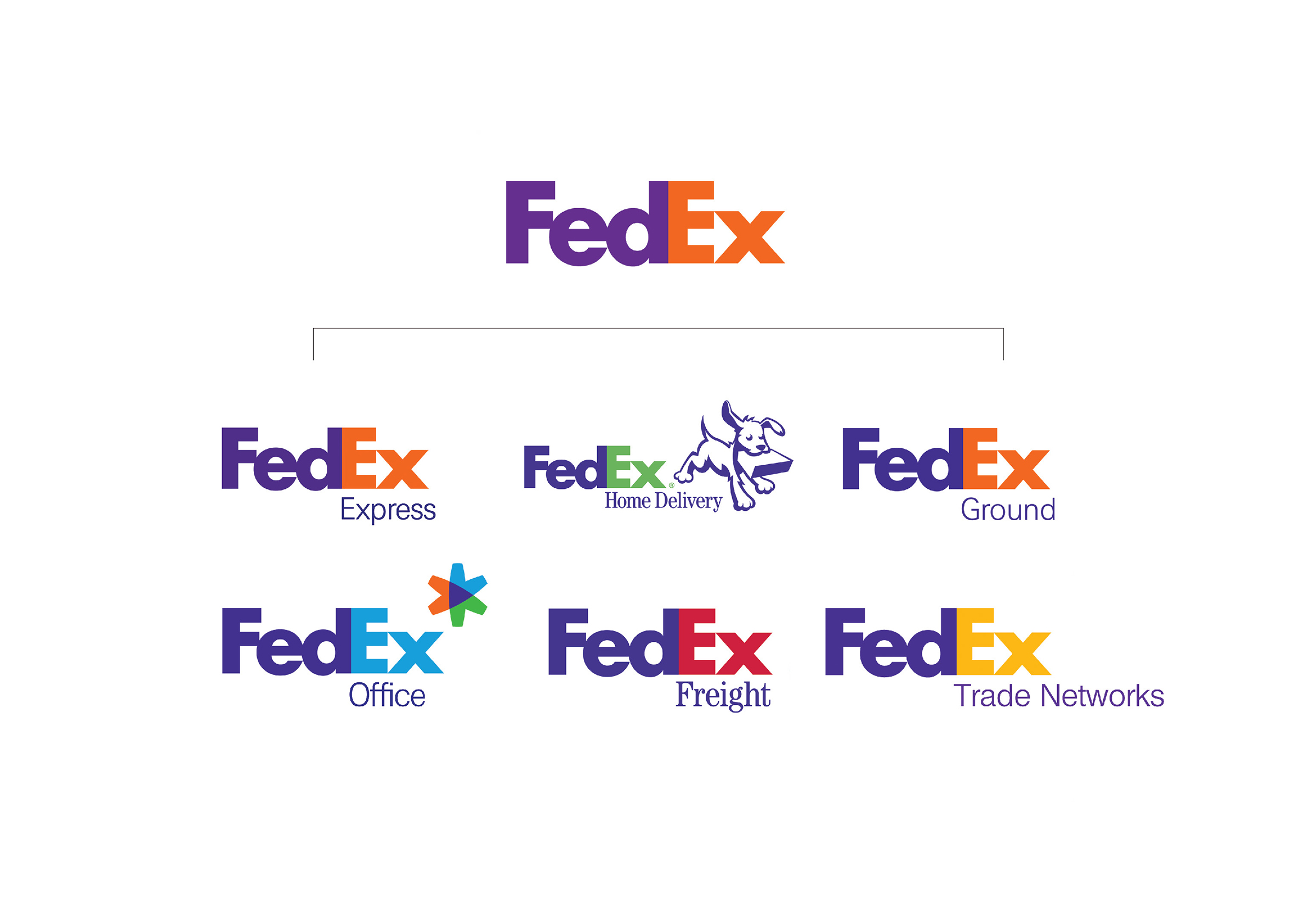
The model that embodies the first extreme is the so-called branded house. In this case, the main brand is always present and it’s the entity that the audience sees and recognizes. Its “variations” are just presented as such, sometimes by adding a new term to the main logo.
One example which is often cited is FedEx: the shipping company is pretty monolithic in the use of its name and logo, even while being a huge global business with many ramifications. FedEx uses different colors to identify its branches and names to identify specific service lines. For example, FedEx Express is orange, while FedEx Freight is red.
Each contains different lines of offer. And yet, the brand appears pretty monolithic. Having a strong brand has a clear advantage: the brand will always be as big as the whole of its business, memorability will be very strong and it will be reinforced cross-target. If a retail customer (eg. FedEx Express) sees a FedEx Freight piece of communication, the FedEx brand is still being reinforced.
In the case of FedEx, this model makes a lot of sense. First, because all of its service lines share many functional and value associations (the company does not own restaurants or sell clothes). Secondly, because in the shipping industry trust is of paramount importance, and trust is built by strong brands.
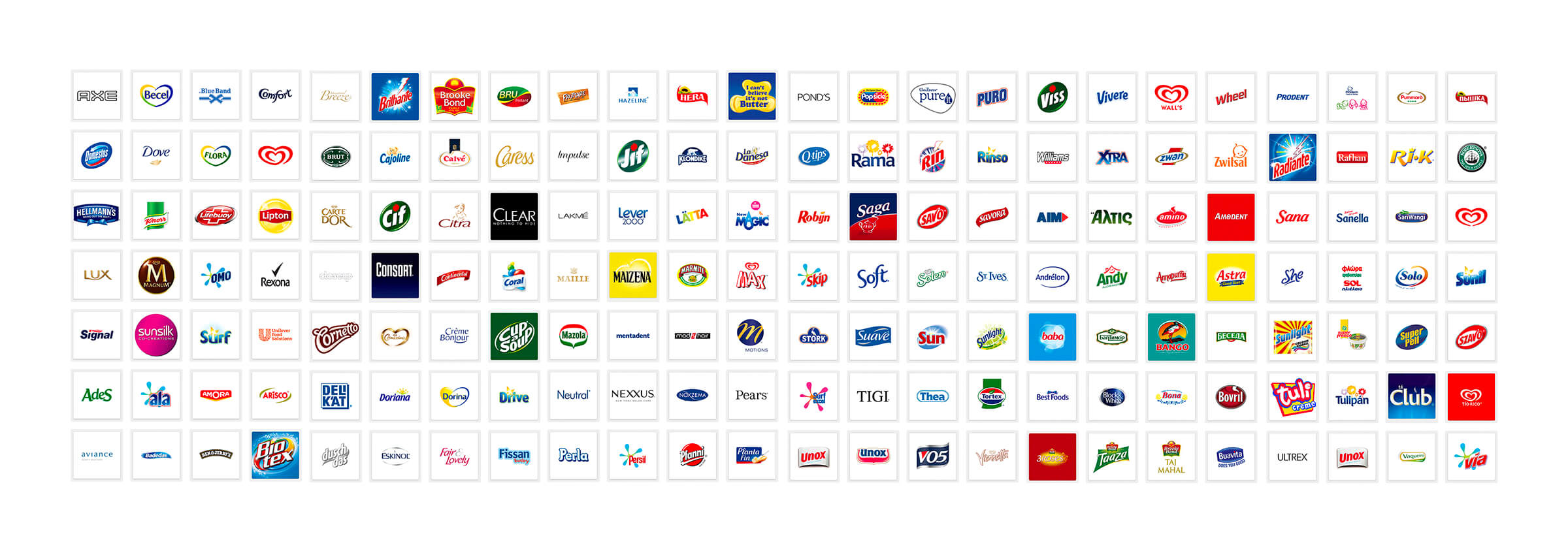
But then, let’s take a look at the other extreme: total brand differentiation. In that case, the main brand becomes almost invisible, while the brands it contains are the real rockstars, the ones exposed to the public. This is what we call a house of brands.
A textbook example for this model is P&G (Procter & Gamble). As we write, the company owns more than 65 brands in different categories, from personal hygiene to home cleaning. Each brand has its own name, identity, communication style. You may not know they are P&G, unless you look closely at the packaging. The same goes for companies like Unilever or Mars.
Wait a minute, wasn’t a strong brand a good thing? Well, in this case the context is completely different. Each brand has a different audience and most importantly different associations so there is really no point in sharing mind space with each other. Just consider that companies like P&G might host overlapping brands like Always and Tampax, offering partly competing products.
While this approach doesn’t build a unified brand memory, it allows for more experimentation by reducing the risk of contagion: if Tide takes a reputational hit, this will not impact Tampax. Actually, most consumers probably don’t even know that the two brands are related.
Of course, this can only work if you have a decent marketing budget allocated for each of your brands, which is the case in the FMCG category, especially at this level.
The numbers make it clear: Fedex and P&G have had very similar revenues for 2024 (between 80 and 90 billion dollars), but FedEx spent 380 million dollars in marketing, while P&G spent almost 10 billion dollars (which amounts to roughly 150 millions per brand).
Different models, different markets, different rules.
What’s in between? The middle ground of brand architecture
Focusing on the extremes gives us a broad picture, but not all companies can afford to take such a stance. More often, a company will start introducing new products as the business grows, and these products will cater to slightly different audiences or need to build specific associations.
When this happens, you can’t bury the main brand, but at the same time you need to build identity for your product or service lines.
And this can happen in many ways. Traditionally, two models are generally considered: sub–brands and endorsed brands. In the first case, the sub brands share a strong family feeling in terms of naming and visual identity, and they carry a strong link to the main brand. In the second case, brands are more independent in terms of identity and the main brand acts more as a “trust seal”.
In the case of sub-brands, the main brand is always very present. Think of Apple. Nowadays, iPhone and Mac are definitely brands in their own respect, and yet you could never forget they belong to Apple: their whole visual and verbal world is Apple–coded (to be honest, Apple’s brand management is truly masterful).
We see the same in automotive, where the 911 is definitely a brand, but not without Porsche, or in software, where Photoshop is its own brand, but not without Adobe. In most cases, when referring to a sub-brand, you will quote the main brand, as in Adobe Photoshop or Porsche 911. This formula works well when you have a consistent product line (all products fall in the same category) but you need to differentiate.
Endorsed brands are a bit different. In this case, you will see the main brand appearing in a more discrete fashion, as a seal of guarantee. The visual family feeling, though, is less present, and sometimes the single brands can differ substantially between themselves.
Unsurprisingly, you will often find this in food, where the reassurance provided by the main brand is less relevant than the fascination that a single brand can provide.
Look at the Cadbury range: while the Cadbury logo is always there, the single candy brand is driving. You crave for a Twirl or a Crunchie, not a Cadbury Twirl. And – plot twist – Cadbury is not even the final boss, as its parent brand is actually Mondelez. In this case, you have a house of brands (Mondelez), whose brand has its own endorsed brands.

The messy reality of brand architecture today
As you can imagine at this point, this is an oversimplification. Look at the real world, and you will find all kinds of nuances for the middle ground and in many cases, a hybrid approach. The reason behind this is you choose the best brand architecture to serve your business, not because it looks clean.
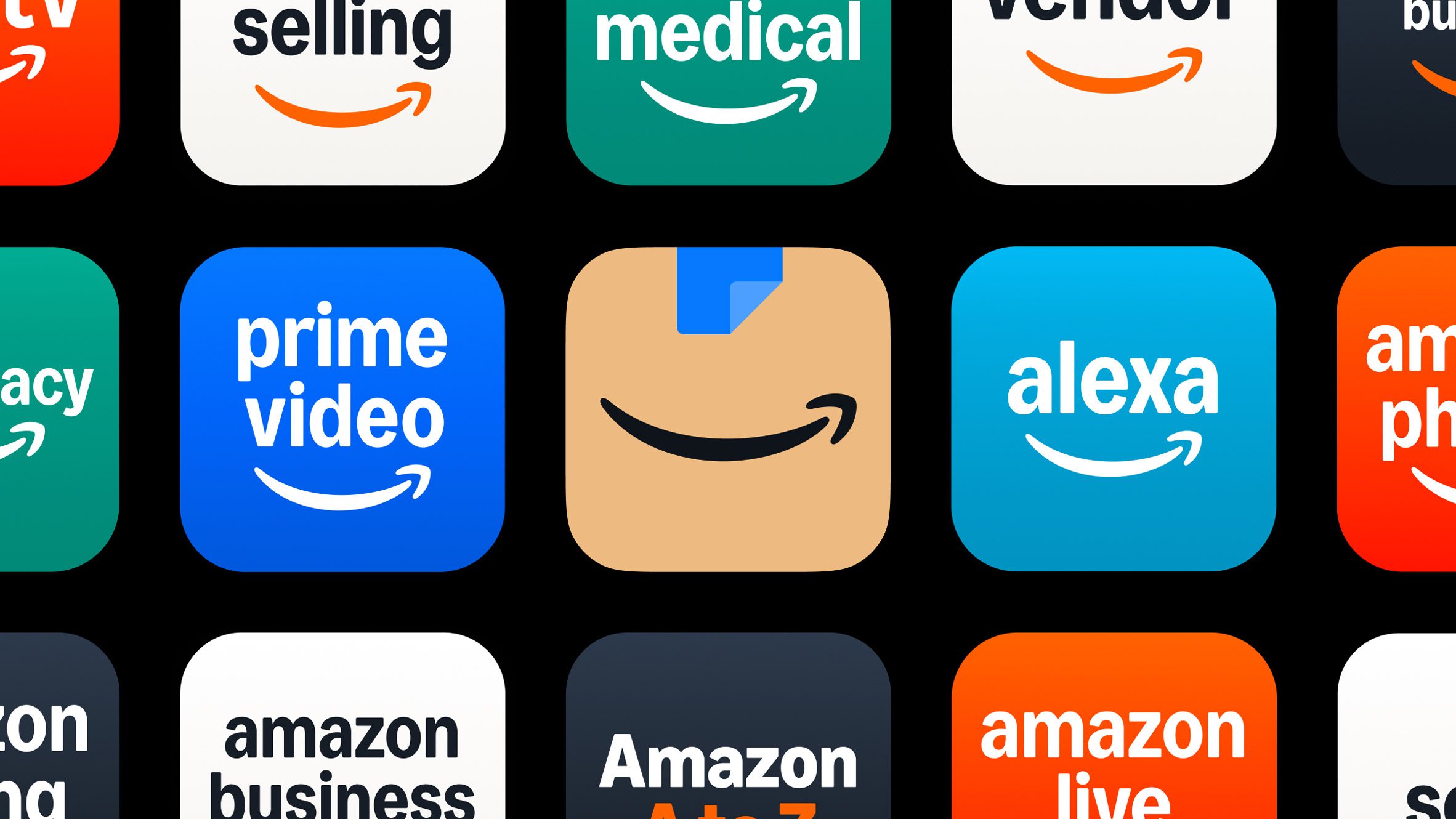
The clearest example of this is Amazon. Born as a small web company and grown into a global mammoth, Amazon has gone through a complete evolution of its brand architecture.
At first, understandably, Amazon was sticking to a branded house approach: it had to build the main brand while it was widening its offer range. You can still see this in Amazon Ads or Amazon Basics.
As the business was growing, you could see the introduction of sub–brands, necessary either because Amazon was acquiring another company with a different market (think Whole Foods) or because one of its sub-brands was becoming too important to the bottom line (think Prime, once Amazon Prime). These brands still retain a strong link to Amazon’s logo and visual identity.
When the brand needs more independence, Amazon has some endorsed brands, too. Audible, for example. And then – being Amazon the giant it is – it also acts as a house of brands, with brands that belong to the company but don’t state it upfront, such as Zappos or Twitch. These brands have their own audiences, and they would not benefit much from getting the Amazon treatment.
So, how do you choose your brand architecture?
Unless you are Jeff Bezos (in that case, hi Jeff!), your company is probably less complicated than the example above. And yet, even smaller companies need to face some hard choices as they grow.
While the right brand architecture is the result of a process, there are some good practices to keep in mind as you approach the matter.
1. Don’t dilute the brand too early
As you “spawn” new business ideas, you might be tempted to create new brands. Remember that this is going to multiply your marketing expenses and hinder your branding efforts. If your company is just starting or has low awareness, this is very risky.
2. Understand how your customer sees you
The level of differentiation within your brand architecture ultimately depends on the breadth of your offer. If you produce both smartphones and meatballs, you might want to use different brands as they are not related. Right? But then if you produce furniture and meatballs, and you are called IKEA, you might do things differently. Because while they are different categories, they fall in the same headspace (the home) and one product is functional to the other.
3. Isolate your experiments
One case when you might want to keep your main brand separate is when you are experimenting with a high chance of failure. In that case, a separate brand can be a better choice to protect your main brand. If things go well, you can incorporate your successful brand later as an endorsed brand or sub-brand.
READ MORE ON

Can AI do your brand strategy?
AI can craft a pretty believable brand strategy, but will it hold? Here are some things to know before you forward it to the team.
Rejected Logo Designs We Still Love
Not all logo designs get accepted. Actually, most of them get rejected, and that’s ok. Here’s why we don’t throw ours away.

Brand equity: why branding is an investment (and how to tell your CFO)
A brand is not a number, but it can bring numbers: when your brand equity is healthy, results follow.

How to Brief Your Branding Agency
Branding can take you anywhere, but do you know where you are headed? Here are some tips on how to brief your branding agency right.
our newsletter
SUMO is one of the few newsletters I don’t archive when my inbox gets full. Each edition feels crafted with care - the links are genuinely interesting, the curation is thoughtful, and the newsletter design itself is a delight to consume.

Content curation at its finest. Doesn't overdo it on commentary, and has probably the highest signal-to-noise ratio among the design newsletters out there. Never a dull entry! Every issue feels handpicked rather than churned out.

Sublimio Monthly is always a breath of fresh air. I especially like how each issue explores one timely theme, turning Andrea and Matteo’s perspectives into a clear takeaway I can immediately apply to my work—often before the topic becomes mainstream.

You know that feeling as a kid, waiting for your favorite magazine to hit the stands? That's what SUMO is for me.

SUMO is much more than a newsletter: it's a guide. In a world of information overload, having someone who does real curation work is invaluable. What I find there is always worth my time. I read it eagerly every time, and I often share it with friends and colleagues because there's always something useful and genuinely interesting.

SUMO has a level of intentionality that sets it apart from most newsletters I read. Each edition is built around a theme that feels considered without being overworked, with Matteo and Andrea’s dual perspectives adding depth and a set of curated links that feel carefully chosen. It’s a newsletter worth reading properly.

SUMO has quickly become one of my favourite newsletters. Every issue leaves me with a fresh perspective on how I see my brand and the world around it.




© 2009—2026 Sublimio


